Leviathan Deep
"The sea remembers what the land forgets"
Overview
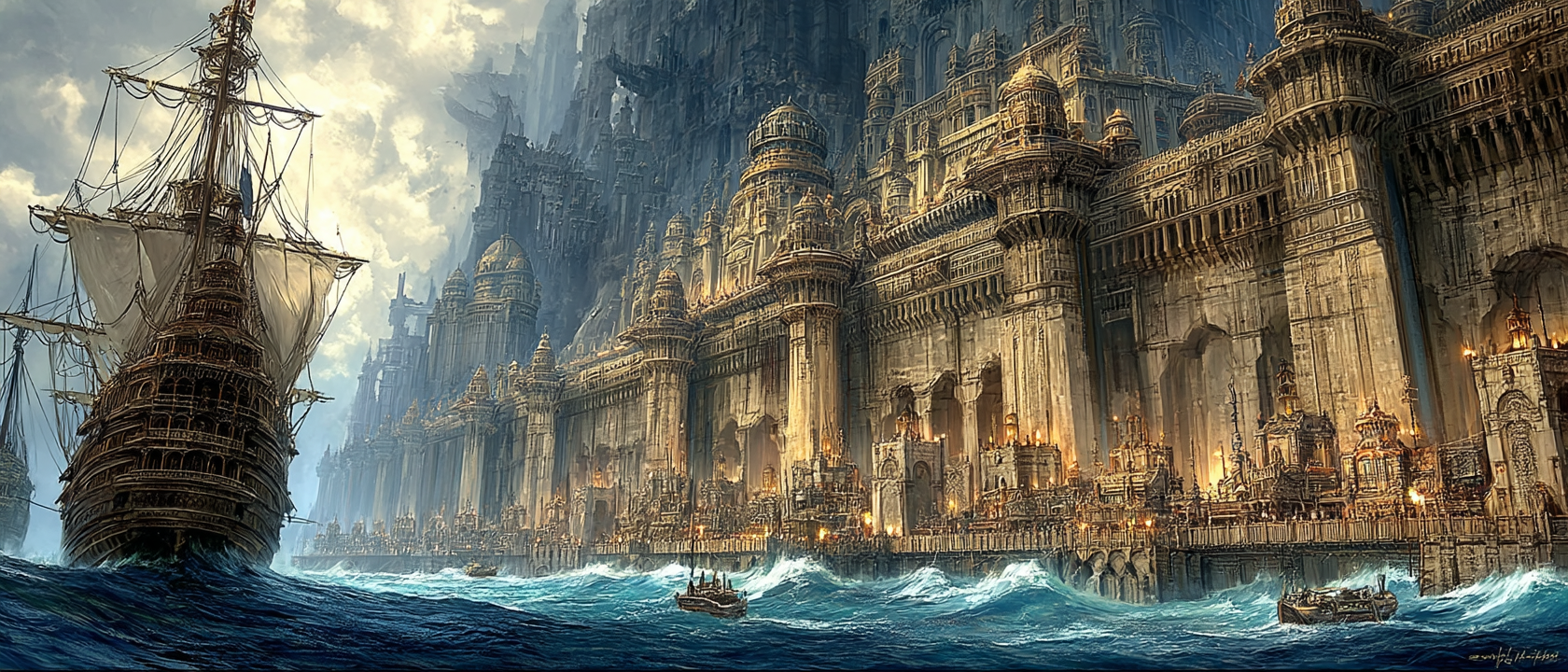
Leviathan Deep rises from the Eastern Sea like a memory carved in stone, the oldest fortress in the Aetherion Dominion, predating even Elyndor itself. But what appears from the outside as black obsidian ramparts and salt-scarred battlements is merely the entrance to something far more extraordinary: a living Aeonic city, carved entirely within the cliffs themselves, still functioning exactly as it did before the Cataclysm.
The citizens of Leviathan Deep do not live atop ancient ruins. They live within them.
Massive stadium-sized chambers honeycomb the black cliffs, connected by corridors wide enough for dragon-drawn carts. Residential districts carved from living rock glow with the warm light of Aeonic lamps that have burned for millennia. Ancient magical wards circulate fresh air through every passage, maintaining comfortable temperatures regardless of the storms that rage outside. Water filtration systems, part technology and part magic, still function with perfect precision, feeding hydroponic gardens where crops grow without sunlight beneath crystalline panels that pulse with soft radiance. The harvest comes on schedule, as it has for three thousand years.
Where the golden current of the Dawnflow River meets the grey tides of the Eastern Sea, House Stormhelm commands both the fortress above and the living city below. The Royal Navy's hundreds of warships fill the massive docks carved into the cliff face. Dragon-drawn skyskiffs launch from platforms that extend over the churning water. But beneath the military operations lies something more precious: proof that Aeonic civilization can endure, that its wonders need not fade, that the old world still breathes.
Yet mysteries remain. Not all chambers have been explored. Some doors refuse to open, their mechanisms locked by systems no living mage understands. Divers speak of structures extending far beneath the waves, towers and causeways that suggest Leviathan Deep was once merely one district of a harbor city that stretched for miles before the Cataclysm claimed it. And the black stone itself remembers, humming faintly when storms approach, as though mourning what was lost while celebrating what endures.
The citizens of Leviathan Deep live as the Aeonic Empire once did. They are the last people in the world who can say that truthfully.
Population & Key Facts
Approximately 10,000 residents within the cliffs
Aeonic Infrastructure
Water Systems
- • Perfect filtration removing salt and impurities
- • Clean water from taps in every residence
- • Hydroponic irrigation for farms
- • Automated waste disposal systems
Lighting & Climate
- • Aeonic lamps burning for 3,000 years
- • Crystal sun in Luminarium (day/night cycles)
- • Comfortable temperature year-round
- • Perfect air circulation throughout
Agriculture
- • Underground farms with special growth lamps
- • Hydroponic systems in perfect balance
- • Harvests on schedule for 3,000 years
- • Feeds 10,000 with surplus
Mysteries
- • Sealed doors that won't open
- • Glowing panels with unknown symbols
- • Humming machinery behind sealed walls
- • Chambers unexplored for millennia
The Exterior Fortress
From the sea, Leviathan Deep appears as a crown of black obsidian rising from the eastern peninsula's cliffs. Salt-scarred ramparts curve to deflect wind and wave, their surfaces carved with runic drainage channels that glow faintly when storms approach. Lightning rods spike toward the sky like thorns. Massive docks extend from the cliff face, housing hundreds of warships, their masts a forest of wood and canvas against the grey tides of the Eastern Sea. Dragon-drawn skyskiffs launch from platforms that jut over the churning water, their riders patrolling the coastline in endless rotations.
At night, those working the docks hear the Umbrix leaving and returning from their hunts. The rush of massive wings, the displacement of air, the distant splash as something vast plunges into the ocean miles offshore. But they never see them. The Umbrix are so black they vanish into darkness itself, invisible predators of the deep water.
But the fortress is only the surface. The true city lies within.
The Dockside Exchange
The transition from the outside world to the Aeonic interior begins at the docks, where massive archways carved with ancient symbols lead directly into the cliffs themselves. The passages are wide enough for freight wagons to pass three abreast, their floors worn smooth by millennia of foot traffic. Aeonic lamps set into the walls at regular intervals cast warm, steady light. No torches, no oil, just illumination that has never faltered in three thousand years.
The archway opens into the Dockside Exchange without ceremony. Stone buildings line the walls like a street transplanted underground, their doorways leading to shops and residences that have stood for longer than the Dominion itself. Open-air stalls crowd the chamber floor where vendors hawk fresh fish, enchanted rope, storm-resistant canvas, and salvaged curiosities from the depths. The smell of salt gives way to bread baking, to oil and metal, to life continuing as it has for generations. Families live here. Children play in the shadow of Aeonic architecture. Everything feels normal until you reach the balcony two hundred yards in.
The Luminarium: Heart of the City
The balcony overlooks a city that should not exist.
Hundreds of feet below, a metropolis of four- and five-story stone apartment buildings spreads across the chamber floor in organized blocks. Streets wind between structures. Market squares open like clearings in a stone forest. People move through their daily lives, carrying baskets, leading pack animals, arguing over prices. Utterly ordinary except for the massive crystalline sun that hangs in the vaulted ceiling so far above that looking directly at it doesn't blind.
The crystal glows with soft, warm light during daylight hours, its radiance indistinguishable from true sun except for the absence of heat. As evening approaches, the light dims to a gentle moonlike glow, maintaining the natural sleep cycles of the people below. No one knows how it functions. No one living designed it. It simply works, as it always has, guiding the rhythm of life in a city that has never seen the sky.
This is the Luminarium. The heart of Leviathan Deep, the last place in the world where people live exactly as the Aeonic Empire intended.
The Branching Tunnels
From the Luminarium, hundreds of passages branch like arteries through the living rock. Some lead to additional residential districts where families have claimed apartments unchanged since before the Cataclysm. Others open into supply warehouses stacked floor to ceiling with rope, canvas, preserved food, and armaments. Livestock areas house goats and chickens in stone pens, their bleating and clucking echoing strangely in spaces designed by an empire that fell millennia ago.
The underground farms stretch through chambers fitted with hydroponic systems and Aeonic lamps that pulse with a different quality of light. Something that makes plants grow without sun, without soil, producing harvests on schedule as they have for three thousand years. Water filtration systems, part technology and part magic, keep everything irrigated and harvested with mechanical precision. Research laboratories, long since repurposed by the Dominion's Genesis Order, contain workbenches and equipment whose original functions remain mysterious. The mages study what they can, document what they don't understand, and hope nothing breaks.
The Sealed Sections
Not all doors open.
Throughout the complex, passages end at walls of ancient Aeonic metal. Surfaces that don't rust, don't corrode, don't respond to lockpicks or prying tools. Glowing panels beside the doors display symbols no living scholar can read. Sometimes the panels respond to touch, shifting through incomprehensible menus before returning to their dormant state. Sometimes they don't respond at all.
The citizens of Leviathan Deep have learned to work around these barriers. They mark the sealed doors on maps, route tunnels to avoid them, and tell children not to waste time trying to open what their ancestors couldn't crack. Some passages lead nowhere. Some promise connection to sections that must exist but cannot be reached. And some, buried deep in the lower levels where few venture, hum with a sound like distant machinery, as though something behind the metal still functions, waiting for someone who remembers how to command it.
The Umbrix Lairs
Separate from the city entirely, isolated passages wind upward through the highest points of the cliffs. Unbonded Umbrix nest in these dark chambers, as far from sunlight as stone and shadow allow. The Aeonic Empire carved these spaces but left them empty, knowing what would claim them. No passages connect the lairs to the inhabited city. No one ventures into their territory. The Umbrix are territorial beyond reason, hostile to any creature not bonded to them, and perfectly willing to roast intruders alive.
Once bonded, an Umbrix follows its rider wherever they are stationed, seeking out sunless spaces. Caves, deep cellars, abandoned mines, anywhere darkness reigns during daylight hours. Exposure to sun makes them miserable, irritable, and dangerous even to their bonded partners.
They hunt at night, diving from cliff perches into the ocean below. Plunging hundreds of feet to snatch small whales, large sharks, anything worth their appetite. Their eyesight in darkness is perfect. Their scales are so black that even against the night sky they vanish completely. Only the sound betrays them: the rush of wings, the displaced air, the distant crash of impact as something massive hits the water miles offshore.
The Depths Below: The Submerged City
Beneath the waves that crash against Leviathan Deep's docks lies proof of what the Cataclysm destroyed. The ruins extend for nearly one hundred miles offshore, a drowned metropolis of shattered towers and collapsed causeways that once connected districts now separated by fathoms of dark water. What stands above, the fortress, the functioning city carved into the cliffs, was merely one neighborhood of something vast.
Divers who brave the depths speak of streets where fish swim through doorways, of archways leading to nowhere, of plazas where statues still stand despite millennia underwater. The structures are Aeonic. Black stone and strange metals that don't corrode, materials that survived submersion when everything else crumbled. Some buildings remain remarkably intact, their interiors accessible to those brave or foolish enough to swim inside. Others have collapsed into rubble fields where salvagers search for artifacts worth the risk.
The water itself makes exploration dangerous. Currents shift unpredictably. Visibility drops to nothing when silt stirs from the bottom. And the ruins create a maze where even experienced divers can become disoriented, their air running low while they search desperately for the surface. Bodies are recovered every few years. Salvagers who went too deep, stayed too long, or encountered something in the darkness that even the sea refuses to speak about.
Living as the Aeonics Did
To live in Leviathan Deep is to live with conveniences most of the Dominion cannot imagine. The temperature never changes. Comfortable year-round regardless of storms raging outside. The air circulation never fails. The lights never go out. Water flows clean and cold from taps in every residence, filtered through systems that remove salt and impurities with perfect efficiency. Waste disposal happens through channels in the floors, carrying refuse to treatment systems no one fully understands but everyone relies upon.
Children grow up playing in streets that have never changed, attending schools in chambers designated for education since before the Cataclysm. They learn to read by Aeonic lamplight. They study navigation by examining charts of coastlines their ancestors mapped. They hear stories of the world outside, of Elyndor's spires, of Valemere's bridges, of the Myrwood's darkness. And many dream of seeing those places themselves.
And they can. The Dawnrunner ferry departs twice daily from the docks, carrying passengers up the golden current of the Dawnflow to Rivergate in a journey of just a few hours. From there, magical carriages make the short trip to Elyndor. People travel for trade, for education, for curiosity. Sailors on leave visit other cities and return with stories, tattoos, and sometimes spouses who move to Leviathan Deep for the opportunity it represents.
Because this is not isolation. This is choosing to live in the most advanced city in the world. A place where infrastructure never fails, where food is always abundant, where comfort is guaranteed by engineering that has outlasted empires. The outside world offers sky and sunlight. Leviathan Deep offers certainty.
The Working City
Most citizens work in industries connected to the sea. The docks employ hundreds. Longshoremen loading and unloading cargo, shipwrights maintaining the fleet, sailmakers stitching canvas in workshops that smell of tar and rope. Merchants operate shops in the Dockside Exchange and throughout the Luminarium, trading goods brought by ship from across the Dominion and beyond. The internal economy thrives on services. Tailors, bakers, blacksmiths, enchanters who maintain the magical infrastructure of daily life.
The Royal Navy dominates the employment landscape. Thousands serve in active duty, rotating through deployments that take them to sea for a year at a time. The four divisions, one hundred ships each, rotate on a carefully planned schedule: one division at sea, another preparing for deployment, a third on home leave, and the fourth in drydock receiving repairs and refits. Sailors spend one year, ten months by Aeonic calendar, on patrol, then return home for two years before deploying again. The system ensures the fleet always has fresh, rested crews while maintaining constant naval presence along the Dominion's coasts.
Families adapt to the rhythm. Wives and husbands say goodbye at the docks, knowing reunion is exactly a year away. Children grow up understanding that their parent serves the Dominion, that the uniform means something, that the ocean demands sacrifice. And when sailors return, the Dockside Exchange erupts in celebration. Reunions, shore leave spending, tattoo appointments, and the simple joy of sleeping in a bed that doesn't rock with the waves.
Ink and Identity: The Tattoo Culture
Walk through the Dockside Exchange on any evening and you'll find the tattoo shops packed. Sailors fresh from deployment getting their traditional "first year at sea" piece. Black Tide operatives incorporating their unit number into Aethrakir patterns. Veterans adding ships to existing sleeves, each vessel a chapter of service. The culture runs deep in Leviathan Deep, brought by sailors who visited ports where body art was tradition and refined by local artists who discovered magical inks that transformed the craft into something unprecedented.
The styles vary wildly. Traditional maritime work dominates. Bold lines, ship silhouettes that rock with movement, anchors that glow near salt water, compasses whose needles actually point directions. Tempest graduates favor storm work: lightning bolts that spark, cloud formations that shift and swirl, wave patterns that flow across skin. The Aethrakir influence brought geometric precision and blackwork bands that speak of endurance survived. And the realistic pieces, deep work the artists call it, feature animated scenes of ship battles, swimming sea creatures, portraits of fallen crew whose eyes follow movement.
The inks themselves make mundane tattoos impossible. Bioluminescent formulas glow in darkness, popular with night watch sailors. Chromatic blends shift color with temperature or emotion. Tide-touched inks react to proximity to seawater, darkening or brightening as the wearer approaches the ocean. Stormborn varieties spark during electrical storms. And the most personal, memorial ash mixed with the cremated remains of fallen crew, creates permanent bonds between the living and the dead.
The best artists have waiting lists months long. Their shops occupy prime locations in the Exchange, their walls covered in flash designs and photographs of completed work. Apprentices practice on pig skin and willing volunteers. And every completed piece adds to the visual culture of Leviathan Deep. A city where skin tells stories of service, survival, and the sea.
Pride of Place
To be from Leviathan Deep is to carry a specific identity. Not the aristocratic pride of Elyndor. Not the mercantile cunning of Valemere. Something harder, earned through service and tested by the ocean itself. Children grow up watching the fleet deploy and return. They learn navigation before they learn history. They understand that the black stone around them has stood for three thousand years and will stand for three thousand more.
Sailors who serve elsewhere in the Dominion carry Leviathan Deep as a badge of honor. "I trained in the War Basin" means something. "I deployed under Stormhelm" opens doors. The tattoos mark them. The accent, sharper, more clipped than mainland speech, identifies them. And the competence they bring to any posting makes commanders grateful and other sailors jealous.
The city functions because its people believe in function. The Aeonic systems work because generations have maintained them with religious precision. The navy dominates because training never stops and standards never slip. And the combination, ancient infrastructure supporting modern military excellence, creates a place unlike anywhere else in the world.
The sea may remember what the land forgets. But Leviathan Deep remembers everything.
Stormhelm House: The Admiral's Seat
Rising from the Luminarium floor like a monument to continuity, Stormhelm House stands apart from the apartment blocks that surround it. Where most residences share walls and crowd together in efficient blocks, the Admiral's residence commands its own compound. A massive structure of ornately carved black stone surrounded by walls that mark the boundary between public and private, between citizen and command.
The Aeonic Empire built this home for whoever governed the city, carving every surface with geometric patterns and flowing designs that speak of an aesthetic three thousand years dead. Columns support archways decorated with maritime themes. Stylized waves, sea creatures whose species no longer exist, ships whose designs predate modern naval architecture by millennia. The main entrance faces the Luminarium's central plaza, its doors twenty feet tall and made of wood so old and well-preserved that scholars debate whether magic or simply superior craftsmanship keeps them functional.
Private gardens occupy the courtyards visible from outside the compound walls. Aeonic lamps designed specifically for plant growth illuminate ornamental trees and flowering vines that have no business thriving underground. Fountains carved from single pieces of stone circulate water in patterns that defy simple gravity. Streams that flow upward, droplets that hang suspended before falling, designs that suggest the original builders viewed water as art rather than utility. These courtyards serve as private green space, a luxury that emphasizes the Admiral's status when most citizens must share the communal Emerald Gardens. To have trees and flowers of one's own, tended by household staff rather than city gardeners, marks the distinction between command and commonwealth.
The Emerald Gardens: The Living Heart
In the center of the Luminarium, occupying two full city blocks, lies the only true green space in Leviathan Deep. The Emerald Gardens stretch across an expanse of carefully maintained soil kept fertile through animal fertilizer and bred earthworms that work the earth in endless cycles. Hardy trees, selected over generations for their ability to thrive under the crystal sun's light, spread their branches overhead, their leaves rustling in the perfectly circulated air. Small ponds fed by the same water filtration systems that serve the rest of the city connect through streams that wind between sitting areas carved from black stone.
Children climb playground equipment that mixes Aeonic carved structures with newer wooden additions built by craftsmen who understood the value of normalcy. Families picnic on grass that has never felt rain but grows thick and green nonetheless. Couples walk the paths in the evening when the crystal sun dims, enjoying the illusion of twilight in a place that has never known true darkness or true day.
The Gardens serve as gathering space for the city's most important events. Naval ceremonies commemorate promotions and retirements here, officers standing in formation while family watches from beneath the trees. Deployment celebrations and return welcomes fill the space with music, food, and the particular joy of reunion. Festivals marking seasonal changes that don't actually affect the underground city happen here anyway, because tradition matters even when divorced from necessity.
The Tattoo Masters
Three legendary shops dominate Leviathan Deep's tattoo culture
Elysium
The Black Anchor
Old Town Ink
The Taverns
The Drunken Harpy
Located in the Luminarium's lower districts. Named for a salvaged Federation figurehead. Clientele: enlisted sailors and dockworkers. Atmosphere: loud, crude, genuinely friendly. Never closes. Entertainment: sailors telling implausible stories, dice games, occasional musicians.
X Marks the Spot
Respectable establishment in the Dockside Exchange. Caters to officers, successful merchants, and civilians who prefer alcohol without violence. Dark wood furniture, table service, extensive drink menu. Strict standards: no fighting, no yelling. Musical entertainment nightly.
The Fallen Stone
In a quiet plaza off the Luminarium's main thoroughfare stands a monument carved by the Aeonic Empire. A pillar twenty feet tall, perfectly circular, covered in ancient names. Leviathan Deep's citizens have repurposed it as memorial.
Below the Aeonic inscriptions, newer names appear: sailors who died at sea, divers who never surfaced, children claimed by disease or accident, anyone the city wished to remember. Skilled stone carvers add names for free, considering it duty rather than business.
Families visit on anniversaries. Sailors leave offerings before deployment. The plaza remains perpetually quiet. People whisper here. Children stop running. Even the Aeonic lamps seem to burn more softly.
The Genesis Archives
Buried in the research districts, far from the public areas, the Genesis Order maintains a facility dedicated to studying the Aeonic systems that keep Leviathan Deep functioning. The Archive is not a library in the traditional sense, though it contains those too, but rather a combination of workshop, laboratory, and emergency response center staffed by mages whose entire careers focus on one question: how does this work, and what do we do when it stops?
The facility houses documentation accumulated over centuries: hand-drawn diagrams of the water filtration systems, maintenance logs dating back four hundred years, every successful and failed attempt to replicate Aeonic technology. Workbenches hold partially disassembled artifacts salvaged from sealed sections or the ruins below, surrounded by tools and measuring equipment that attempt to understand manufacturing techniques that predate modern magic by millennia.
The mages who work here are not the combat-trained Tempest graduates or the ambitious researchers seeking glory. They are quiet specialists who find satisfaction in understanding rather than innovation, who measure success in systems that continue functioning rather than new spells developed. When something breaks, and occasionally something does, these mages respond with the speed and seriousness of emergency medical care, because in Leviathan Deep, the death of infrastructure could mean the death of the city.
Access is restricted. The work classified. And the stakes absolute.